
Home-Molds
Molds
Loading...
Steel Formwork Systems
IndustrialSteel Formwork Systemsfor Concrete Product Manufacturing
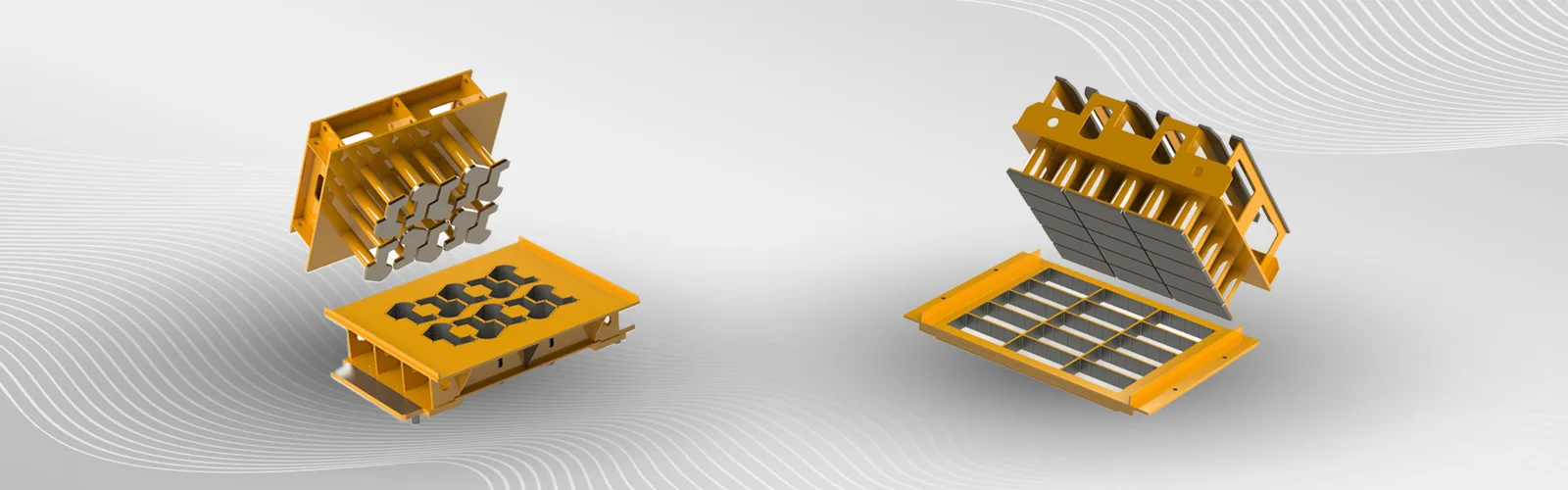
We design and manufacture high-precision, long-service-life steel mould systems for paving stones, concrete blocks, kerbstones and custom concrete products.
During the mould design process, the technical parameters of the production machine are carefully considered to ensure full system compatibility.
STAGES
Mold Production Stages

Step 1
Project and Technical Drawing Analysis
Every production process begins with a detailed project analysis and technical drawing review. Solid models and technical data provided by the customer are evaluated by our engineers to determine the most appropriate method for production. This stage is critical in terms of both the mold's durability and production efficiency.

WHAT YOU WANT TO KNOW
FAQ – Molds
Different types of steel, such as ST52, C45, and Hardox, are used in steel mold systems for concrete product manufacturing. Steel selection is determined based on production volume, press pressure, and operating intensity. Higher-strength steel is preferred in facilities with intensive and continuous production.
Yes. Mold production is designed according to the technical measurements and connection system of your existing machine. A compatible mold design is made based on the machine brand and model information.
Special molds can be produced for concrete blocks, paving stones, curbs, and other concrete products based on technical drawings or samples. The design process begins after a project-based evaluation.
Mold revision is evaluated after technical review. In some cases, revision offers an economical solution, while in others, new mold production may be more efficient. The decision is made after analyzing the current state of the mold.
Production time varies depending on the mold type, dimensions, and steel preference. There may be differences in time between standard productions and custom design projects. A technical evaluation is required for detailed information.
The lifespan of formwork depends on the type of steel used, production intensity, concrete mix, and maintenance routine. The right choice of steel and regular maintenance directly affect formwork performance.
Concrete molds are packaged and shipped in accordance with international shipping standards. Surface protection and secure crate packaging are provided.
When designing molds, the machine's vibration system, press pressure, and connection points are taken into account. Production stability is targeted by ensuring system integrity.
The service life of a mold is not determined by a single number, but by the conditions of use. For this reason, our steel mold systems for concrete product production are designed to provide reliable and long-lasting performance under different working conditions.
Under standard working conditions, our molds are manufactured according to engineering calculations to provide a service life of 100,000 presses.
However, the actual mold life may vary depending on:
The properties of the raw materials used
The technical condition of the machine
Pressure and vibration settings
Regular maintenance practices
The selected steel grade (ST52, C45, Hardox, etc.)
In cases of unexpected wear, the mold condition is technically evaluated, and solutions are proposed when necessary. The goal is not merely to produce molds but to ensure production continuity.
Yes. It is possible to produce different concrete products by changing the molds on concrete block and paver production machines.
Machine systems are designed to work with steel mold systems for concrete block production. With appropriate mold changes, the following can be produced:
Paver
Brick
Curbstone
Ramp stone (Maza)
Grass paving stones
Custom-designed concrete products
can be produced.
However, it is important that the mold design and machine technical specifications are compatible in terms of production performance and stability. The design should be made taking into account technical parameters such as the vibration system, press pressure, and pallet size.
A properly designed mold-machine compatibility plays a critical role in production quality and efficiency.